Re: AMD Graphics news
Napsal: úte 28. led 2014, 15:45
Diskuze o hardware, software a overclockingu
https://forum.pctuning.cz/
Ale jasné že tam sú nejaké údaje. Otázka ale bola iná. Je/bude tam informácia o minimálnej refresh rate z hľadiska použiteľnosti na dynamickú synchronizáciu obnovovania? Ak by to tak bolo, bolo by to super, ale to tam v tom texte explicitne nepíšu.Krteq píše:Mimochodem, údaje o refresh rates jsou skutečně vyčítány z EDID

Summary
Extend the “MSA TIMING PARAMETER IGNORE” option to DisplayPort to enable source based control of the frame rate similar to embedded DisplayPort.
Intellectual property rights
N/A
Benefits as a result of changes
This enables the ability for external DisplayPort to take advantage of the option to ignore MSA timing parameter and have the sink slave to source timing to realize per frame dynamic refresh rate.
Assessment of the impact
The proposed change enable per frame dynamic refresh rate for single stream devices that expose dynamic refresh rate capability in EDID for DisplayPort interface. The source will be able to enable this with an SST interface or MST hub with physical ports. Logical MST port support of the feature is not included as part of this SCR. A generic framework to enable such feature for logical port is required that can accommodate other feature where stream related configuration is programmed in DPCD.
Analysis of the device software implication
SST device which support “MSA TIMING PARAMETER IGNORE” option will be able to expose the capability in EDID and DPCD to let source enable dynamic refresh rate.
Source driver would have to be updated to parse EDID and enable “MSA TIMING PARAMETER IGNORE” feature when source want the sink to be refreshed based on its update rate.
Analysis of the compliance test and interop implications
Currently this feature is tested as part of eDP CTS. New test would have to be added as part of DP LL CTS and EDID CTS.
 (viz. prvních pár postů v tomto vlákně)
AMD’s display engines have supported variable VBLANK for a couple of generations...
...AMD simply needed driver support for controlling VBLANK timing, which is present in the latest Catalyst drivers. AMD hasn’t yet exposed any of the controls to end users, but all of the pieces in this demo are ready and already available...
To that end, the VESA sends word today that they have done just that with the latest update to the DisplayPort 1.2a standard. Adaptive-Sync (not to be confused with NVIDIA’s Adaptive V-Sync), the eDP feature that allows for variable refresh monitors, has been added to the DisplayPort 1.2a standard as an optional feature. We’ve been expecting this addition since AMD first announced their FreeSync concept, however until now it wasn’t clear whether Adaptive-Sync would first be added to DisplayPort 1.2a or rolled into the forthcoming DisplayPort 1.3 standard, so we’re glad to see that it’s the former rather than the latter...
...AMD is telling us that as of this point most of their GCN 1.1 products will support Adaptive-Sync, including the desktop Radeon 290 and 260 series, along with AMD’s low-end APUs: Beema/Mullins and even Kabini/Temesh. Kaveri however is not listed as of this time. For all of the supported products the underlying hardware is already Adaptive-Sync capable, so it’s just a matter of AMD rolling out support for it in their drivers...
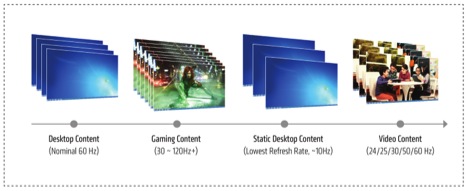
...AMD’s release also contains an interesting note on supported refresh rates: “Potential ranges include 36-240Hz, 21-144Hz, 17-120Hz and 9-60Hz.” While the upper-bounds of those ranges are in-line with numbers we’ve seen before, the sub-30Hz refresh rates on the other hand are unexpected. As you might recall from our look at G-Sync, even though LCD monitors don’t suffer from anything quite like phosphor decay as CRT monitors do, there is still a need to periodically refresh an LCD to keep the pixels from drifting. As a result G-Sync has a minimum refresh rate of 30Hz, whereas AMD is explicitly promising lower refresh rates. Since the pixel drift issue is an underlying issue with the LCD technology there is presumably something in Adaptive-Sync to compensate for this – the display is likely initiating a self-refresh – though at the end of the day the variable refresh rate means that you can always set the refresh rate to a multiple of the targeted refresh rate and get the same results.

 ( tedy ne že by tak moc vadilo, jsou to už 3 roky staré karty byť stále slušně výkonné.)
no je to ale jako s Mantle a GCN 1.0, podpora slíbená, ale bůh ví kdyUPDATE 14:10: Podle informací, které získala redakce webu Anandtech, jsou uvedené modely GPU a APU prvním hardwarem, který bude v době uvedení podporovaný. Neznamená to tedy, že by hardware generace GCN 1.0 byl vyloučen, pouze zatím není na seznamu (pravděpodobně probíhá testování a rozhoduje se o případné podpoře).

AMD Demonstrates Prototype FreeSync Monitor with DisplayPort Adaptive Sync FeatureThe demo system is powered by an AMD FX-8350 processor and Radeon R9 290X graphics card. The monitor is running at 2560x1440 and is the very first working prototype of the new standard. Even more interesting, this is a pre-existing display that has had its firmware updated to support Adaptive Sync. That's potentially exciting news! Monitors COULD BE UPGRADED to support this feature, but AMD warns us: "...this does not guarantee that firmware alone can enable the feature, it does reveal that some scalar/LCD combinations are already sufficiently advanced that they can support some degree of DRR (dynamic refresh rate) and the full DPAS (DisplayPort Adaptive Sync) specification through software changes."...
...The time frame for retail available monitors using DP 1.2a is up in the air but AMD has told us that the end of 2014 is entirely reasonable. Based on the painfully slow release of G-Sync monitors into the market, AMD has less of a time hole to dig out of than we originally thought, which is good.
How is Project FreeSync different from NVIDIA G-Sync?
There are three key advantages Project FreeSync holds over G-Sync: no licensing fees for adoption, no expensive or proprietary hardware modules, and no communication overhead.
How does Project FreeSync utilize DisplayPort™ Adaptive-Sync to determine the period of time a frame is displayed to the user?
An AMD Radeon™ graphics card compatible with Project FreeSync uses the DisplayPort™ Adaptive-Sync specification to automatically determine the minimum and maximum refresh rates supported by a dynamic refresh-ready system. Using this approach, no communication must occur to negotiate the time a current frame remains on-screen, or to determine that is safe to send a new frame to the monitor.
By eliminating the need for ongoing communication with pre-negotiated screen update rates, Project FreeSync can execute highly dynamic changes in frame presentation intervals without incurring communications overhead or latency penalties.